LVMH Clienteling System
2019-2020
The client relationship management system (Clienteling) can assist salespeople in better managing customers, scheduling meetings, reaching out to customers, handling repairs, and understanding data like monthly turnover.
Luxury brands typically have their own brand styles and customer management requirements. After providing this service to many luxury brands under LVMH, we have decided to summarize a set of methodology and templates, which will be utilized for modularly constructing future systems and promoting our universal solutions.
A methodology.
A design template.
A series of derivative solutions.
↓
*Due to brand-sensitive information, virtual products are adopted in some scenarios. Only partial product pages and processes are displayed.
Part 1
First thing first,
build a standardized framework
Role
Product Designer
Period
2019/09 - 2020/02
1.Identifying touchpoints: a service blueprint approach
My first responsibility is to conduct in-depth research on past customer experiences of luxury brands like LV and Dior. I analyze how customers interact with customer managers, what their pain points are, and what aspects of the service lead to high customer satisfaction. This involves gathering and studying relevant data, such as customer feedback, service records, and case studies.
By working with the product team, we are able to identify patterns and a service blueprint. This blueprint serves as a strategic guide that maps out the entire customer service process. It clearly defines the interactions between customers and customer managers, as well as those between back-end management and customer managers.
This will help us define various touch points. And according to the needs of each touch point, ultimately, it will be precipitated into the product's functions.

2.Build the design template based on user scenarios
The product design is created based on user stories. For example, in the customer reach out part, the story goes like this:
"As a salesperson, my goal is to effectively analyze new products, identify the right clients to reach out to, and determine the best course of action for each individual client.
I start by receiving information from the "New Collection/Catalog" section pushed by my company, this gives me details about the latest products.
I use the "KPI Analysis" tool to understand the potential performance metrics of these new products.
I review the product information provided, including features, benefits, and any unique selling points.
I go to client segmentation to identify clients who have shown interest in related products or have a need that the new product can fulfill.
For each potential client, I review their profile, their purchase history, and any previous interactions.
Based on the client's profile and preferences, I formulate personalized product recommendations. I prepare a communication plan or use a template that highlights how the new product can add value to the client's life or business.
I schedule follow-up calls or meetings if needed, using the "Take Appointment" feature. I ensure that I provide any additional information or answer any questions the client may have during this process."
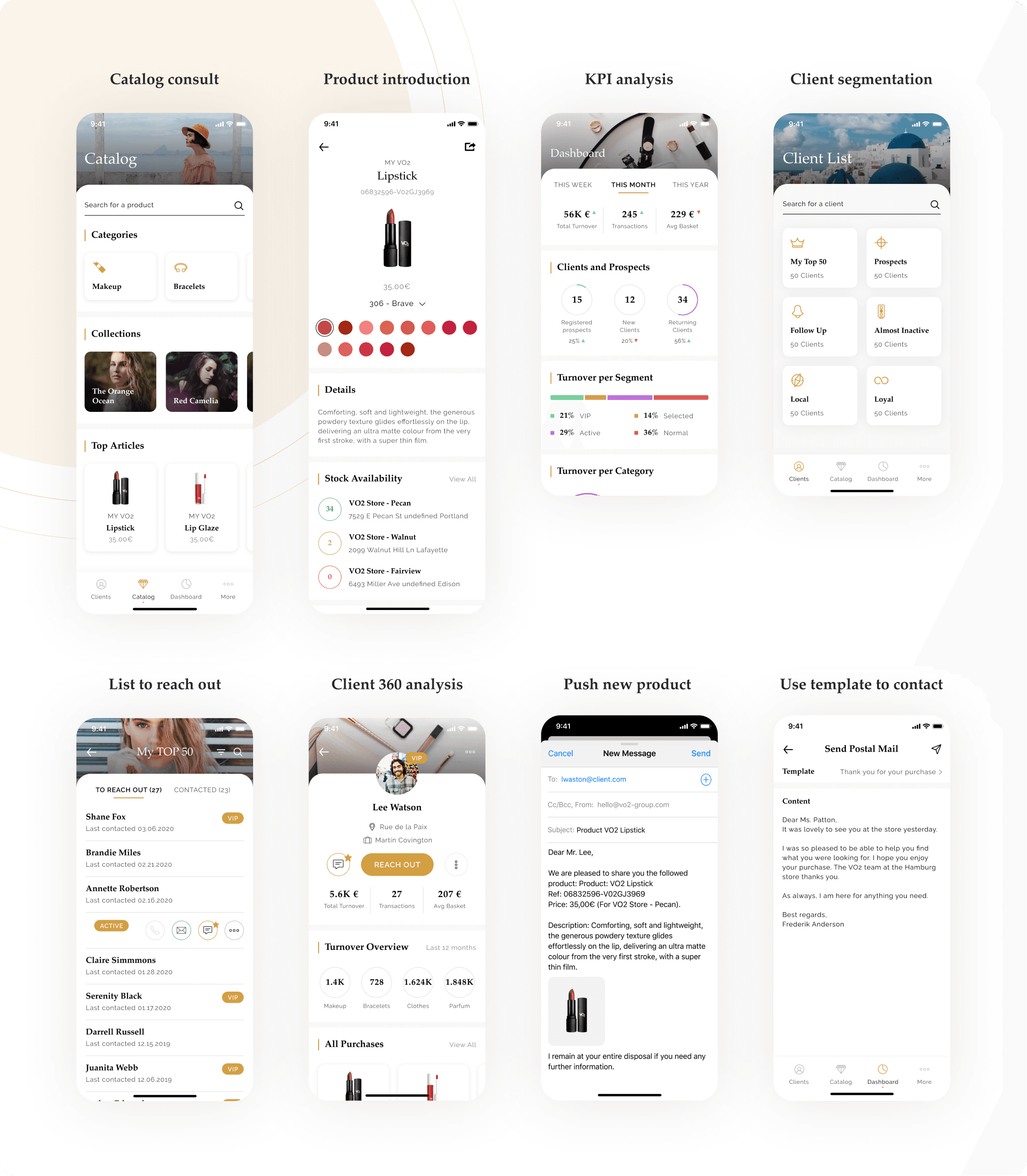
Through detailed analysis of customers, it helps in determining the next steps for sales decisions.

Part 2
Customization for other brands: features, structure and user interface
Role
Product Designer
Period
2019/08 - 2020/06
1.Build different navigation systems according to customer needs
The needs of different brands' salespeople are deeply understood at the start.
For example, as a cosmetics brand, Guerlain has relatively frequent customer purchases. For Guerlain's sales team, they need a customizable calendar to manage their busy schedules. So, we carefully analyze how they interact with customers and what features can help them track customer trends and promote new products.
Similarly, as a luggage brand, Rimowa attaches greater importance to after-sales service and maintenance functions. Therefore, Rimowa's salespeople need to register tasks easily to facilitate handling after-sales issues.

2.An example: Agenda for Guerlain
As previously mentioned, the salespeople of Guerlain want a customizable calendar, which can help them manage their schedules more effectively and enable them to pay better attention to customer-related events.

3.An example: Analysis system for Rimowa
Rimowa highly values after-sales service and maintenance. It is crucial for its salespeople to quickly take notes and create relevant tasks for each client.
This involves designing an interface that allows them to quickly understand customer's activity history, and record details of after-sales issues, such as the type of problem (e.g., damaged handle, broken zipper), the customer's birthday, and any relevant notes.
